
Defense Production Is Accelerating. Can Your RF Interconnect Supplier Keep Up?
By Mary Weber, Manager NA Mil Aero Sales
 The U.S. defense industrial base is under unprecedented production pressure. Missile and radar systems, unmanned and next generation aircraft, electronic warfare and counterattack programs are all accelerating simultaneously. Major defense contractors have agreed to ambitious ramp rates, in some cases committing to quadruple output of critical mission systems over the next several years, placing extraordinary demands on suppliers throughout the defense supply chain.
Supply chain fragility is one of the most consequential risks in defense manufacturing. Smaller suppliers unable to absorb prolonged volatility or fund the facility investments required to surge have closed, creating component-level bottlenecks that ripple upward through the entire supply chain. Skilled labor and raw materials remain constrained. Lead times stretch on parts that programs can’t afford to wait for. And as conditions across the defense industrial base have made clear, the gap between plausible consumption rates and achievable production rates is not a problem that can be solved simply by scaling output. Managing a production ramp-up is fundamentally an organizational challenge that requires the right infrastructure, disciplined processes, and a supplier base that is prepared to scale.
For mission program managers and procurement leads, the question is not whether demand will surge; it already has. The question is whether the suppliers on their approved lists have the capacity, the infrastructure, and the organizational readiness to scale alongside them. In too many cases, the answer is no. The ones that can answer yes have invested in this for years.
Seven Decades of Mission-Critical Manufacturing
Times Microwave Systems has been solving RF interconnect challenges for defense’s most demanding platforms for nearly seven decades. That portfolio spans military aircraft and helicopters, cutting-edge unmanned aerial vehicles, missile systems, and the ground-based radar and sensor suites that support them. That breadth is not incidental; it reflects a sustained institutional commitment to understanding what mission-critical performance requires across an enormous range of operational environments and platform types.
That history matters today: it means Times Microwave Systems has spent decades building the manufacturing infrastructure, supplier relationships, and engineering processes that companies are now trying to build under compressed timelines. Rather than reacting to today’s defense demand, Times Microwave has continually invested in the capabilities needed to support it.
Speed, Readiness, and the Ability to Buy Down Risk
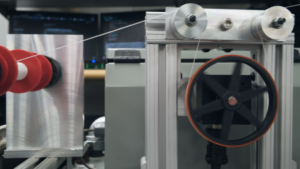 When mission program managers assess their RF interconnect supply chain right now, three requirements rise above all others: speed, operational readiness, and risk reduction. Those aren’t aspirational criteria; they’re the practical qualifications that determine whether a supplier belongs on a program or gets replaced by one that does.
Speed: This means more than fast delivery. It means a supplier who can compress the timeline from design engagement to production-ready supply, who can support rapid qualification without forcing a program to generate data from scratch, and who can respond when schedules shift.
Readiness: The production floor, the equipment, the workforce capacity, and the supply chain behind the supplier are already set up to scale, not planned to be.
Risk Reduction: Buying down risk means reducing the program’s exposure at every stage: qualification risk, second-source risk, sole-source dependency risk, and the risk that a supplier’s own constraints become the program’s problem.
These are the standards Times Microwave Systems has always built its capacity strategy around. These requirements have always existed. What the current environment has done is make the gap between suppliers who meet them and suppliers who don’t impossible to ignore.
A Manufacturing Ecosystem Built for Surge
Times Microwave Systems operates a distributed manufacturing network across three North American facilities, each equipped for cable and connector production, RF testing, and assembly. That distribution isn’t just a logistical advantage; it’s a production resilience structure. When one location faces a disruption, the others absorb it, and deliveries remain uncompromised. The footprint behind that redundancy spans 140,000 square feet in Wallingford, CT, 63,000 square feet in Mesa, AZ, and 25,000 square feet in West Palm Beach, FL.
But geographic distribution alone doesn’t create surge capacity. Equipment investment, process modernization, and supply chain infrastructure do. Over the past several years, Times Microwave Systems has systematically upgraded its production capabilities: adding braider lines, extruder lines, and tape lines across its facilities, transitioning from manual tension controls to automated systems, and installing new tape machines with in-line testing that enables continuous quality monitoring during production rather than after. The majority of these additions are coming online in the third quarter of this year, producing a meaningful step-change in output capacity, particularly from a tape core perspective.
“We’ve invested and expanded and now have many more options available to us,” said Bill Setzer, Business Unit Director at Times Microwave Systems. “We’re still a first-shift company, with significant room to expand. We have the space, the equipment, and the operational flexibility to ramp up output without increasing lead times for our customers. When they scale, we’re already prepared to scale with them.”
The numbers behind those words are concrete. Times Microwave Systems regularly ships five million feet of cable per month globally and produces 16,000 assemblies and 30,000 connectors per month in North America. The company is also advancing semi-automated assembly processes for a variation on certain assemblies. The initiative targets a 60 percent reduction in manual termination steps through a combination of precision machining operations and induction soldering, a process improvement that increases both throughput and production consistency at the same time.
Supply chain management has been overhauled alongside the production floor. A dedicated sourcing team supports the ongoing qualification and onboarding of new suppliers, expanding access to a broad supply base and reducing dependence on any single source. Combined with the broader Amphenol ecosystem, which provides access to expanded machining capabilities, RF test chambers, qualification test equipment, and global manufacturing resources, Times Microwave Systems has the vertical integration and supplier diversification depth to navigate the material constraints that have disrupted less-prepared organizations.
Engineering Excellence That Buys Down Program Risk
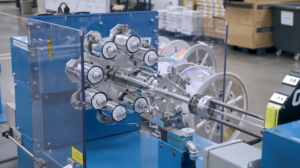 Production volume is necessary but not sufficient on its own. Program managers need confidence that a supplier can be qualified quickly, that second-source transitions won’t introduce schedule compression, and that scaling production won’t degrade the performance that mission-critical applications require. That confidence is built through engineering capability.
Because Times Microwave Systems designs its products in-house and maintains a large, mature product portfolio — spanning TFlex®, PhaseTrack®, MilTech® , SiO2 , and Levitate™ assemblies — the company can support rapid design-ins and provide direct crosses to existing assemblies on a program’s approved parts list. That depth also enables qualification by similarity: Times Microwave Systems carries existing test data across a broad range of products and performance envelopes, allowing new programs to leverage prior qualification work rather than bearing the full cost and schedule impact of starting from scratch. In an environment where qualification timelines are a program risk factor in their own right, that existing data is a meaningful asset.
Second-sourcing is another area where the in-house design philosophy pays dividends. When a program needs to add a qualified supplier, whether to increase throughput or transition away from a supplier that can’t meet ramp requirements, Times Microwave Systems’ large portfolio of cross-compatible products makes the qualification path shorter and the transition less disruptive.
Micro-Coax: Extending the Vertical Integration Advantage
The capacity story extends beyond Times Microwave Systems’ own facilities. Additional manufacturing capacity comes through Micro-Coax, whose vertically integrated operations provide additional capacity to meet cable, connector, and precision assembly needs. Micro-Coax’s 93,000-square-foot facility is AS9100 Rev D and ISO 9001 certified, featuring a Class 10,000 cleanroom, an in-house plating lab, and hermeticity testing capabilities. Critically, Micro-Coax operates its own CNC machine shop, giving it a level of vertical integration that most RF interconnect suppliers in the market cannot match.
Micro-Coax products include UTiFLEX® assemblies, semi-rigid bulk cable and assemblies in traditional and SiO2 configurations, and ARACON® braided solutions, all serving the same mission-critical defense markets Times Microwave Systems has supported for decades.
That vertical integration has direct implications for both production continuity and speed-to-program. Where supply chain bottlenecks on machined components would stall other manufacturers, Micro-Coax can produce those components internally, eliminating a category of supply chain risk at its source. The result is rapid prototyping capability that delivers proof of concept in weeks rather than months, and a structural resilience to the component shortages that have disrupted programs across the defense industrial base.
The Ramp Ahead Is Broader Than It Looks
Missiles and UAVs represent the most acute demand signal today. But program managers who are planning ahead recognize that the production pressure currently concentrated in those platforms is a preview of what’s coming for the broader defense electronics supply chain.

Ground-based radar systems, airborne detection and sensor suites, counter-drone technologies, and the full complement of support systems required by next-generation platforms will generate the same volume and qualification pressure that missile production is generating. The RF interconnect requirement doesn’t go away as platforms evolve. In many cases, it intensifies.
“What we’re hearing from the market is that military assets need to be produced and fielded faster than ever,” said Radicchi. “We are working close with our customers to ensure they understand that we’re prepared to support these needs as critical defense programs ramp up.”
Times Microwave Systems has spent the last several years preparing for precisely this environment. The facilities are expanded and in place. The equipment investments are already coming online. The supply chain infrastructure has been rebuilt around resilience and diversification. The engineering resources to support rapid qualification, design-in, and second-source transitions have been deepened. And through Amphenol, Times Microwave Systems can draw on a global manufacturing and technical ecosystem that provides capacity and capability well beyond what any single facility could offer.
As defense production continues to accelerate, manufacturing capacity alone won’t determine which programs stay on schedule. The differentiator will be suppliers that combine production scalability with engineering depth, diversified supply chains, and the ability to shorten qualification timelines. This acceleration in demand across the defense industrial base will highlight the competitive advantages of a supplier readiness — not just for the manufacturers, but for every program they support.
“We don’t just build high-performance RF solutions,” said Setzer. “We build them efficiently, reliably, and at the capacity our customers require. When demand shifts, we move with it. We’re open for new business, and ready to scale when you are.”
Subscribe to our newsletter!
Interested in receiving email newsletters and other updates from Times? Subscribe now!