
RG-58 vs. LMR®-195 Coaxial Cable Webinar Summary & Key Takeaways
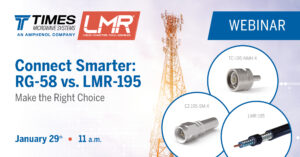 This webinar explores why upgrading from RG-58 to LMR®-195 coaxial cable can significantly improve performance and reliability in modern RF applications. While RG-58 remains widely used, its outdated design and inconsistent quality can lead to higher attenuation, poor shielding, and reduced durability. LMR-195 offers superior electrical and mechanical characteristics, making it the better choice for applications requiring consistent, long-term performance.
Watch the video or read the session notes below.
Session Notes
Why RG-58 Is Still Common—and Why It’s Time to Upgrade
RG-58 has been around since the 1940s and was originally designed for UHF/VHF applications. Today, it’s still used in higher-frequency environments like 900 MHz ISM, 2.4 GHz, and GPS, despite its limitations. RG-58’s solid polyethylene dielectric and single braid shield result in higher attenuation, lower shielding effectiveness, and poor UV resistance. Quality varies widely because RG58 is no longer a controlled military standard, making consistent quality and reliability difficult to ensure.
The Advantages of LMR-195
LMR-195 was introduced to provide a drop-in replacement for RG-58, offering compatibility with existing connectors while delivering major performance improvements:
- Lower attenuation thanks to a nitrogen-injected foam dielectric with skin-foam-skin construction.
- Superior shielding with bonded aluminum tape and heavy tinned copper braid for up to 90 dB shielding effectiveness.
- Enhanced durability with a black polyethylene jacket for excellent UV resistance and moisture ingress protection.
- Consistent quality through tight process controls and rigorous testing.
Ease of Installation
LMR-195 works seamlessly with Times Microwave Systems’ CST prep tools and EZ connectors, making field installation fast and reliable. No braid trimming is required, and IP67-rated connectors ensure environmental sealing. Modular connector designs allow for custom configurations, while standard interfaces like SMA, BNC, TNC, and Type N cover most applications.
Identifying Clones and Ensuring Authenticity
Counterfeit or clone cables often lack proper bonding, shielding, and testing, leading to failures in the field. Genuine LMR cables are clearly marked with Times Microwave Systems branding, cage code, and “Made in USA” designation.
Key Takeaways
- LMR-195 delivers lower attenuation, stronger shielding, and improved long-term durability
- Advanced construction ensures consistent, reliable RF performance
- Fast, easy installation with CST tools and IP67-rated EZ connectors
- Authentic LMR-195 from Times Microwave Systems prevents clone-related failures
FAQ
Q: How does LMR-195 compare to RG-58 in terms of flexibility?
A: LMR-195 is available in an UltraFlex construction, which is the most flexible version of the cable while still delivering high RF performance. While RG-58C/U is slightly more flexible, that small gain in bendability comes with significant tradeoffs — including higher signal loss, weaker shielding, reduced UV resistance, lower power handling, and incompatibility with CST prep tools. LMR-195 UltraFlex offers an optimal balance of flexibility, durability, and electrical performance for modern RF applications.
Q: Where can I purchase the cable stripping tools for LMR-195?
A: The stripping tools are available through any of our authorized distributors. You can view a complete list of distributors and their contact information by clicking the “Distributor” tab located in the upper-right corner of our website.
Q: How many blade-life cuts on the strip tool?
A: In testing, the CST stripping tools consistently performed well beyond 2,000 cable preps using the original blades, with clean cuts and reliable results. Replacement blade kits are also available and include multiple blades and hardware—providing enough capacity for 10,000+ preps to support long-term, high-volume installations.
Subscribe to our newsletter!
Interested in receiving email newsletters and other updates from Times? Subscribe now!